Humidity in Southeast Asia and Your Wood Furniture: A Singapore Buyer's Guide
I live in Tampines, three floors up in an HDB block built in 2009, and the first piece of solid wood furniture I ever owned — a 1.6 m teak dining table from a local showroom — cupped so badly within eight months that a SGD 4 coin could rock back and forth on the seam between two leaves. The culprit was not the wood, and it was not the maker. The culprit was the air. Singapore's relative humidity runs between 65 % and 95 % for most of the calendar year, and indoor humidity in a corner unit on the top floor rarely drops below 70 % even with the air-conditioner on for sixteen hours a day. If you are shopping for a solid wood sofa frame, a bed frame, a wardrobe, a nightstand, or a marble table here, this is the single most important fact about your home: it is, by global furniture standards, a hostile environment for kiln-dried timber.
Why does Singapore humidity warp wood furniture so quickly?
Wood is a hygroscopic material, meaning it constantly exchanges moisture with the surrounding air until it reaches an equilibrium moisture content (EMC). Most European oak, ash, and walnut that ships into Southeast Asia is dried at the factory to an EMC of around 8 %–10 %, which suits a temperate climate. Singapore's indoor EMC sits closer to 16 %–19 %. That 8-point gap is enormous: a 2 m oak table top will swell roughly 4 mm across the grain when it absorbs the missing moisture, and the same physics that swells it will eventually shrink it again in a February air-con binge. The result is cupping, bowing, gaps between boards, and cracked finish.
Three local factors amplify the problem. First, HDB and condo corridors are narrow — most are 1.2 m to 1.5 m wide — which means your furniture spends more time sitting on a covered walkway during delivery, soaking up warm humid air, than furniture does in Helsinki or Denver. Second, lift doors in older blocks are only 0.9 m wide, so a 1.8 m dining table cannot be delivered fully assembled; it has to be broken down and re-assembled inside your flat, where joints that were glued and clamped under factory compression now have to hold against movement the joinery was never designed for. Third, GST at 9 % adds roughly that percentage to the landed cost of an imported piece, which can tempt buyers toward cheaper, under-dried stock that has had less time in the kiln. That is the worst possible trade-off in a tropical climate.
Is solid wood actually safe to buy here, or should I choose engineered wood?
Solid wood is absolutely safe to buy here — provided three things are true of the maker. The timber should be dried to a target EMC appropriate for the destination, not for the country of origin. The joinery should allow movement: floating tenons, breadboard ends with slotted screw holes, and table tops attached with figure-8 clips rather than glued-down. And the finish should be one that slows moisture exchange — a catalysed conversion varnish, a hard wax oil such as Osmo, or a marine-grade polyurethane, rather than a thin nitrocellulose lacquer that breaks down in two seasons.
I visited the MIDHILL workshop in Foshan last October with a colleague who was sourcing a Post-modern light luxury marble table for her new Punggol Waterway residence. The kilns there run at 45 °C for between 30 and 45 days depending on board thickness, and the moisture meter readings they pull on finished stock sit between 10 % and 12 %. That is closer to Singapore's indoor EMC than what most European makers ship, which is why the brand's ten-year structural warranty — unusually long for the category — is not just marketing language. A bed frame or dining table that is delivered at the right moisture content will move less in service.
How do I choose a mid-century modern for a balcony?
You do not, unless the balcony is fully enclosed with air-conditioning running year-round — mid-century modern furniture is built for dry interiors (typically 35 %–55 % RH) and will deform within one wet season on an open balcony.
This is a question I get from buyers in Punggol and Bedok every month, often phrased as "I want a teak console for my balcony" or "can I put a walnut credenza on my service yard." The honest answer is no, not if the space is open on three sides. Outdoor humidity in Singapore hits 100 % during the monsoon transitions in April and October, and condensation forms on cold metal and stone surfaces overnight. A marble table on a balcony is actually a worse idea than a wood one — the polished stone sweats, anything wooden sitting on it wicks that moisture straight up the legs, and within a year the base swells while the top stays cool and dry, splitting the joint apart. Keep balconies for resin, powder-coated aluminium, and woven polyethylene. Save the solid wood bed frame, the solid wood sofa frame, and the marble dining table for inside the air-conditioned envelope of the flat itself.
What wood species actually hold up in a Tampines or Bedok HDB flat?
From worst to best in our climate: pine and rubberwood at the bottom — they dent, stain, and move dramatically; oak in the middle — beautiful but thirsty; teak, acacia, and white ash above that — naturally oily and dimensionally stable; and at the top, reclaimed Burmese teak and kiln-dried white oak from makers who actually understand tropical EMC. The catch with the top tier is price: a 1.8 m solid white-oak dining table from a workshop that understands Singapore will run SGD 2,800 to SGD 4,200 delivered, while a comparable-looking piece from a flat-pack retailer sits at SGD 1,200 to SGD 1,600. The SGD 1,600 difference is, in plain terms, the cost of the kiln time.
If your budget is closer to SGD 1,800 for a dining table, look at acacia or ash with a hard-wax-oil finish you can refresh yourself every eighteen months. MIDHILL's catalogue includes acacia dining tables in the SGD 1,950 to SGD 2,400 range with free shipping above US$350 (about SGD 470) and a 14-day return window, which gives you time to judge cupping in your own home before committing. For a wardrobe, expect to pay SGD 3,200 to SGD 6,500 for a 1.8 m to 2.4 m solid ash or teak piece; anything lighter is almost certainly veneered MDF with a wood-grain print, which performs better against humidity than solid wood but cannot be sanded and refinished the way solid stock can. That refinishability is a real lifetime benefit — the same brand offers lifetime refinishing on structural pieces, so a thirty-year-old wardrobe can be sanded back and re-oiled for a few hundred SGD rather than replaced.
How should I acclimatise a new dining table or bed frame after delivery?
Leave it in the room it will live in for at least fourteen days before you move it into final position, with the air-conditioner running on a timer if possible. Wipe it down with a clean, dry microfibre cloth every morning for the first week to lift the surface condensate that forms overnight. Do not place it against an exterior wall for the first month — those walls run 2 °C cooler than interior partitions in a corner unit and condense moisture right onto the back of the piece. Keep it 10 cm to 15 cm away from the wall to allow air circulation.
For a solid wood bed frame, the same rules apply, with one addition: rotate the mattress 180° every three months. Mattresses absorb roughly 1.5 L of moisture from the air over a humid week, and that moisture sits against the slats. If the slats are raw softwood — common on cheaper bed frames — they will mildew inside two years. Ask for hardwood slats, ideally ash or beech, and oil them once a year the same way you would oil the table top. A nightstand is the easiest piece to manage because it is small and the air-conditioner moves a lot of air around it; just keep coasters under everything ceramic or glass, because rings are the most common refinishing job I see on Singapore-bought stock.
Does a marble table need different care than a wood one in this climate?
Yes, and the difference matters. Marble is calcium carbonate, which reacts with anything acidic — citric juice, vinegar, wine, even some skin lotions — and etches within seconds. In Singapore, where residents cook with sambal, belacan, and calamansi daily, an unsealed marble dining table will be visibly etched within a month. The fix is a penetrating sealer applied at the factory and re-applied every twelve months at home; budget SGD 80 to SGD 150 for a quality sealer that covers a 1.6 m table. French light luxury interiors often pair a honed (matte) marble surface with an oiled oak base precisely because honed marble hides the micro-etching that develops in daily life, whereas a polished finish shows every ring and splash.
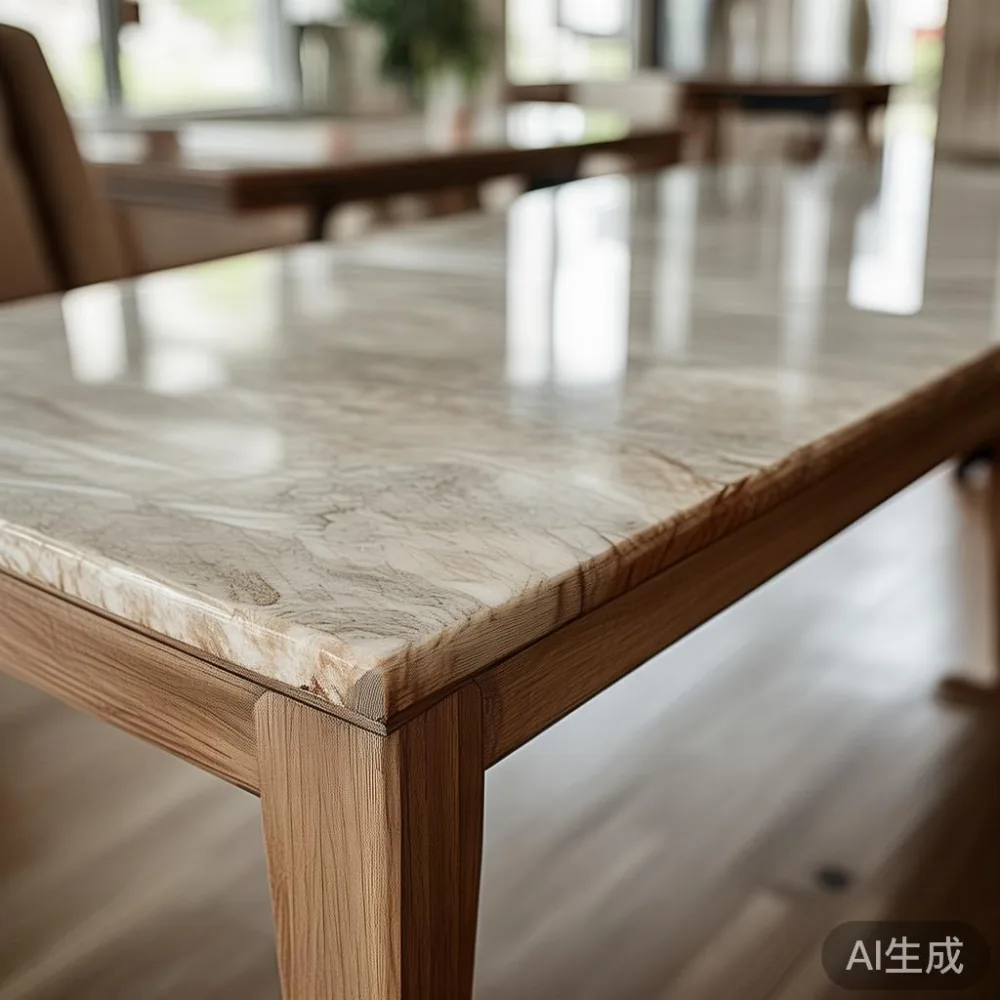
One quirk of marble in our humidity: the stone itself is dimensionally stable, but the wooden substrate beneath a marble table top is not. A 1.8 m marble top weighs between 95 kg and 130 kg depending on thickness, and that mass sits on a frame that is still moving. Quality makers isolate the two — the marble is held in a metal cradle or a felt-lined rebate, never glued directly to the wood — so the frame can expand and contract underneath without cracking the stone. This is one of the engineering details I look for when I am advising buyers in Bedok and Punggol, and it is the kind of detail that separates a SGD 4,000 marble table from a SGD 12,000 one even when the visible materials look identical. A Post-modern master bed for pet owner with an attached marble-topped bedside element, for example, has to be designed with this isolation in mind, or the stone will crack the first time the timber moves.
What about pets, children, and daily wear in a HDB flat?
Two dogs and a cat, in my case, which is why the practical advice here comes from scar tissue. Claw marks on a solid wood sofa frame are unavoidable with cats; the question is how the frame is finished. A catalysed finish will resist claw puncture better than a hand-rubbed oil, but it cannot be spot-repaired — the whole panel has to be refinished. An oiled finish can be spot-sanded and re-oiled in twenty minutes with a 220-grit sanding sponge and a lint-free cloth, which is why I prefer oiled ash or acacia for households with pets. Urine is the bigger enemy: it is acidic and will etch marble within seconds, and it will blacken oak within hours if not wiped up. Keep a roll of paper towels and a bottle of pH-neutral stone cleaner next to every marble surface in the house.
Children add impact damage rather than chemical damage, and the answer there is rounded edges and thicker stock. A dining table with a 35 mm to 40 mm top will absorb a dropped toy without denting; a 22 mm top, common on flat-pack pieces, will dent every time. For a solid wood bed frame, look through-bolted corner brackets rather than dowel-and-glue joints — the bolts can be re-tightened every five years as the wood moves, which is a ten-minute job with an Allen key rather than a call to the carpenter.
Quick numbers to keep in your head while you shop
Singapore indoor humidity target: 55 % to 65 % RH. Wood movement per 1 % EMC change on a 2 m oak board: roughly 0.5 mm across the grain. Acceptable factory moisture content for delivery to Singapore: 10 % to 12 %. Minimum acclimatisation period after delivery: fourteen days. Hard-wax oil re-coat interval: twelve to eighteen months. Marble sealer re-coat interval: twelve months. Slat material on a bed frame: ash, beech, or birch, never softwood. Top thickness for a family dining table: 35 mm minimum. Free shipping threshold with MIDHILL: orders over US$350, roughly SGD 470. Return window: fourteen days. Structural warranty: ten years on frames. Refinishing: lifetime on qualifying pieces.
The short version is that buying solid wood furniture in Singapore is not harder than buying it anywhere else — it just rewards buyers who understand what they are buying and who the maker is. Ask about factory moisture readings, ask about the finish system, ask how the marble is isolated from the timber, and ask what the warranty actually covers. The pieces that survive twenty years in Tampines, Bedok, and Punggol are the ones where someone answered those questions honestly at the showroom.