Humidity and Solid Wood Furniture in Singapore: A Practical Guide from the MIDHILL Workshop
I still remember the first time I walked into a Tampines HDB flat on a wet Tuesday afternoon to deliver a 3-seater TV console for living room. The lift opening measured 2.1 m tall by 1.1 m wide, the corridor bend at the 7th floor was tight, and the owner had already placed a dehumidifier running at 40% relative humidity. She told me her previous wooden console had cracked across the grain within six months. That delivery, more than any spec sheet, taught me what Singapore humidity does to wood — and what a homeowner can actually do about it.
Foshan, where MIDHILL has built solid wood pieces since 2008, sits in the Pearl River Delta at an average yearly humidity of 78%. Singapore sits even higher, often between 75% and 90%. Both climates punish furniture that was never designed to breathe. Below is what fifteen years of building solid wood sofa frames, bed frames, dining tables, wardrobes, and nightstands has taught our team, specifically for Singapore HDB flats in estates like Bedok, Punggol, and Tampines, and for the larger condos going up around the CBD.
Why Singapore's humidity is different from a European or American climate
Wood is hygroscopic. It absorbs and releases moisture until it reaches equilibrium with the air around it, known as EMC, or equilibrium moisture content. In London, EMC sits around 12%. In Singapore, it sits between 16% and 19%. That gap matters: every 1% change in moisture content causes roughly 2-3% dimensional change across the grain in hardwoods like walnut, ash, and oak.
Translation in plain numbers: a 200 cm wide solid wood dining table made with European ash kiln-dried to 8% will, in a Tampines HDB without air conditioning, swell to around 204 cm wide during the December monsoon, then shrink back to 198 cm by the dry week of a Chinese New Year heatwave. That 6 cm swing, repeated across four seasons a year, is what opens joints, lifts veneers, and splits panels.
The thing most buyers miss is that Singapore does not have a single humidity problem. It has two. From November to February, the Northeast Monsoon pushes humidity above 85% almost daily. Then the dry spell from late January to early March can drop indoor humidity to 55% if you run a 24-hour air-conditioner, with windows closed. Your dining table, your wardrobe doors, your marble table top on its wooden base, all have to survive both swings in a single quarter.
What "solid wood" actually means in a humid climate
Engineered boards — plywood, MDF, particleboard — handle humidity better in some ways because the cross-grain layers slow movement. But they also delaminate at the glue line once humidity stays above 80% for weeks. A true solid wood piece, built from one piece of timber per panel, is actually easier to repair. You can sand it, re-oil it, fill a crack. You cannot easily fix a swollen MDF door.
At MIDHILL we kiln-dry our walnut, ash, and beech to 8-10% moisture content before machining. That number is not a marketing line. It is the level at which the wood is stable enough to machine tight tenons and not crush the fibers during assembly. When the same piece arrives in a Punggol condo and sits in air-conditioned air at 18% indoor humidity, the wood will slowly absorb moisture and expand by 1-2% across the grain over the first three months. That is normal. It is not a defect, and you can manage it.
How do I care for a master bed in humid weather?
Wipe the frame weekly with a dry microfiber cloth, run a dehumidifier set to 55-60% relative humidity in the bedroom, leave 10 cm of airflow behind the headboard, and never store wet laundry on or under the bed.
That is the short answer. Now the longer version, because a master bed is the most expensive solid wood piece most Singapore households will ever own, and most care guides written for Europe do not apply here.
Step one is airflow. Push the bed 8-10 cm away from the wall. Most HDB master bedrooms in newer BTOs measure about 3.4 m by 3.2 m, which sounds generous, but once you add a king-size mattress (180 cm by 190 cm by 25 cm thick, typical weight 38 kg) and a solid wood bed frame (ours weighs 55-70 kg depending on slat count), you only have about 60 cm of walking space on each side. Enough for airflow. Never push the frame flush against a plaster wall.
Step two is moisture control. A 12-litre dehumidifier costing S$180-S$260 from any local electronics chain, running 8 hours a day in the bedroom, will pull indoor humidity from 82% down to 58%. At that level, your solid wood bed frame and any matching nightstand will hold its shape. Check the dehumidifier tank daily — in a Bedok HDB, a single unit can pull 1.2 litres in 12 hours during peak monsoon weeks.
Step three is bedding hygiene. Beds in Singapore rarely get the deep airing that European beds do. Open the bedroom window and the main door for 20 minutes every morning while you shower. This is a small thing, but it drops the localized humidity under the mattress by 4-5%.
Step four, and most people skip this: rotate the mattress 180 degrees every two months. A memory foam mattress that sits in 80% humidity without rotation will sag on the side nearest the wall because the wood slats underneath absorb moisture and bow. A solid wood slat system, like the ones we build into MIDHILL bed frames, holds shape better than the metal frames sold at S$399 in big-box stores, but it still benefits from even airflow.
Last month I visited a customer in a Punggol Waterway Ridges condo. She had owned our king-size bed for 14 months. The frame was perfect. The headboard had a faint watermark near the right corner where her ensuite shower steam had drifted in. The fix took 20 minutes: light sand with 320 grit, re-oil with our standard hardwax, buff with cotton. No replacement needed. That visit took me 3.4 metres down a 1.2 m wide corridor and up a lift with a 2.4 m internal depth. We measured twice before the original delivery. Worth the trouble.
Specifics for wardrobes, dining tables, and that marble table you have been eyeing
Wardrobes are the most vulnerable piece in any HDB flat. Their back panels sit against walls that, in older flats in Tampines and Bedok, are not perfectly sealed against the service yard moisture. A 2.4 m tall wardrobe in our workshop weighs between 90 kg and 130 kg depending on the door count. It needs 4 cm of clearance at the back for air movement, otherwise the back panel — usually 18 mm plywood with a wood veneer — will wick moisture and push the doors out of square.
Dining tables face a different problem: the top is the widest single piece of wood, and it is the first surface to show cupping when humidity rises. Keep tablecloths off the surface for at least the first 60 days, because trapped moisture under a vinyl or fabric cloth creates a microclimate that discolours the finish. Use coasters, ideally felt-bottomed, under every cup, especially for cold glasses that condense in air-conditioned rooms.
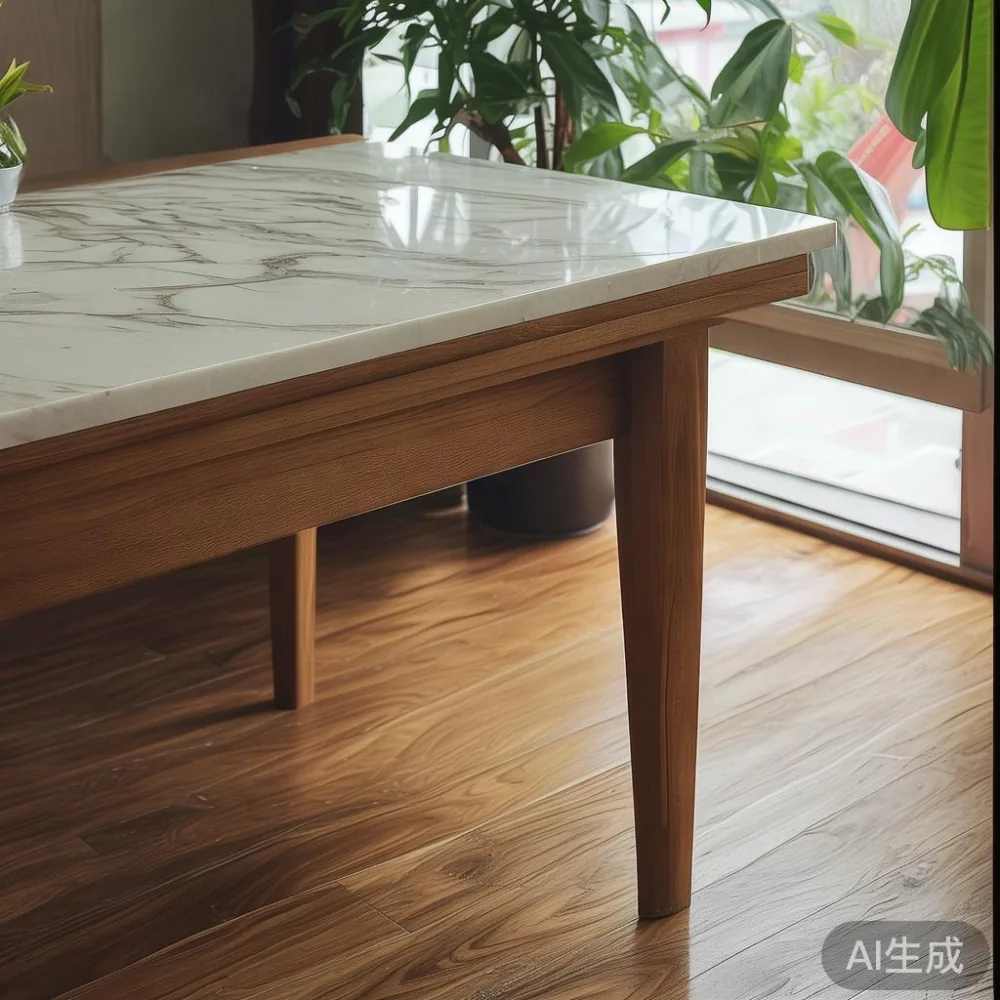
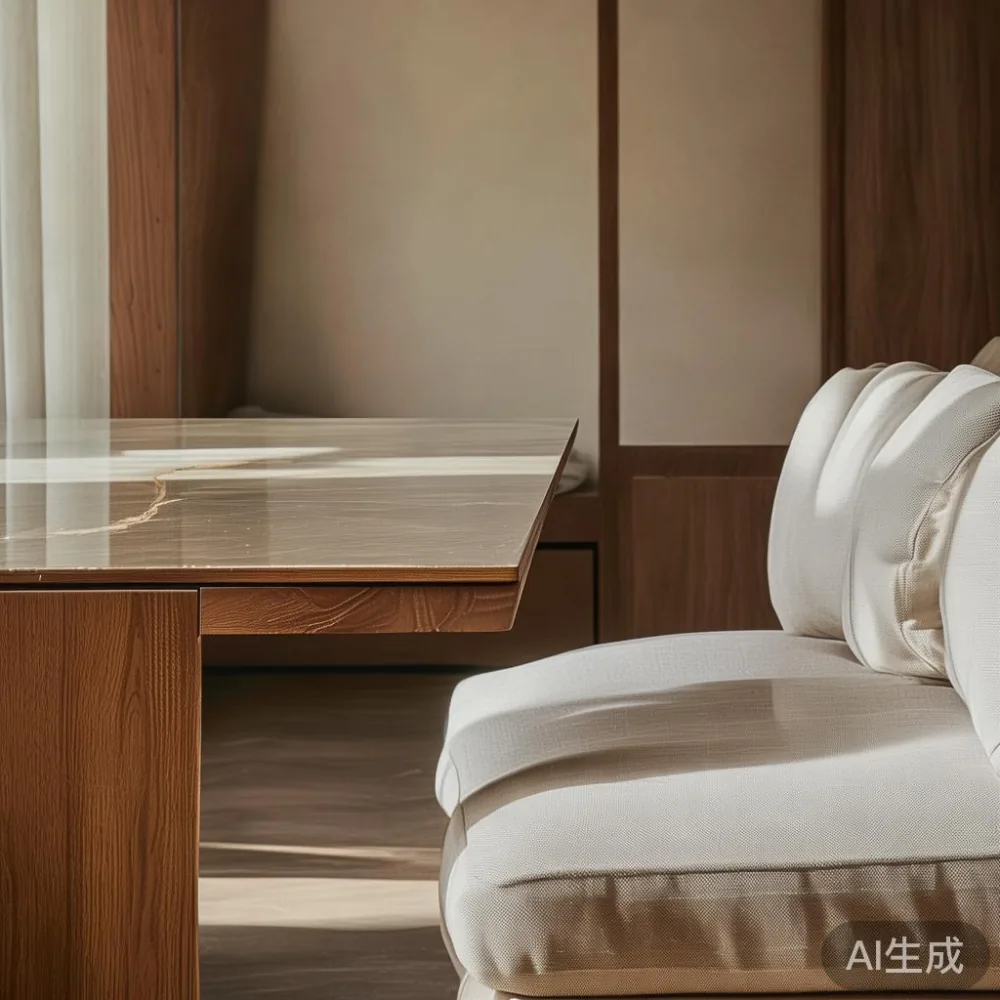
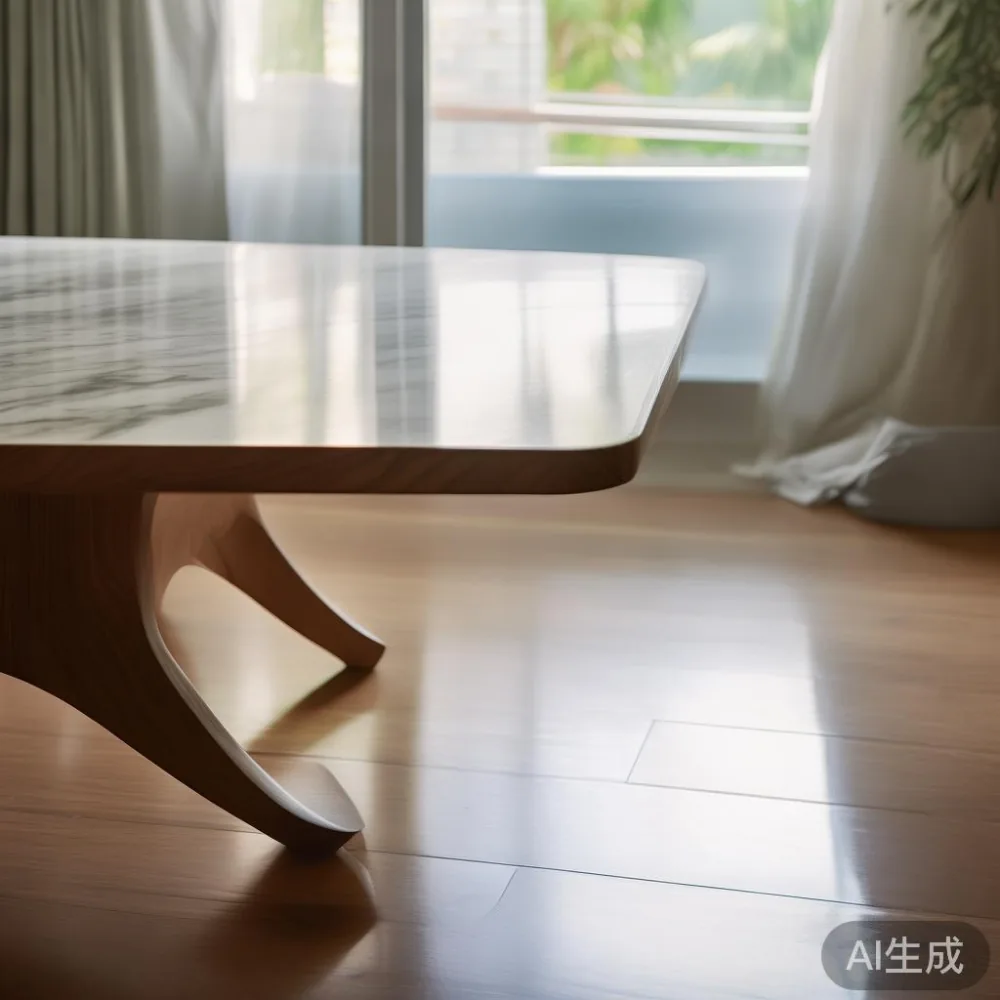
A marble table is a special case. Solid marble is dense and dimensionally stable, but the wooden base underneath is not. Our marble table collection uses an Italian Carrara top (each slab around 38 kg for a 140 cm round) bonded to a kiln-dried ash base. The marble does not move. The base moves around it. The trick is the mounting system: we use a flexible silicone adhesive that allows the base to expand by 1-2 mm in any direction without cracking the marble. Treat the marble with a penetrating sealer once every 12 months, and wipe spills within 10 minutes so the citrus acids in lime juice do not etch the polish.
If you are choosing between a wooden dining table and a marble table for a Tampines HDB dining area, the marble table is the lower-maintenance option for humidity, but it costs more upfront and needs more careful handling during delivery. A marble top cannot be carried up a HDB staircase that turns at a 90-degree corner narrower than 1.4 m. Our delivery team has handled over 2,000 marble table installations across Singapore, and we have a dedicated hanging-strap system for lift doors narrower than 0.9 m. Worth asking any retailer about their marble delivery method before paying the deposit.
Real costs, real numbers, and what to budget for in SGD
Dehumidifier, 12-litre, suitable for a 4-room HDB room: S$180-S$260, one unit per bedroom plus one for the living area.
Hardwax oil maintenance kit for a solid wood dining table or wardrobe, enough for two coats on a six-seat table: S$65-S$90, lasts roughly three years between full re-oils.
Hygrometer, digital, with min/max memory so you can track overnight humidity peaks: S$22-S$40 from any electronics chain.
Professional re-oiling service for a 200 cm dining table, done by our team in your flat, typically 2-3 hours on site: S$220, travel included within mainland Singapore. For customers who bought a MIDHILL piece, lifetime refinishing is included as part of the original purchase, which over 15 years works out to roughly S$80 per year if you take up the offer four times.
Delivery within Singapore, including the S$15-S$35 GST on most furniture and the lift-survey checklist that our logistics team runs before dispatch: free for orders above US$350 (about S$475). Below that, standard delivery is a flat S$60 to anywhere in mainland Singapore, Sentosa included, Jurong Island excluded.
Returns window, no questions asked: 14 days from delivery. The piece must be unused, in original packing, and re-delivered to our Punggol warehouse between 9 am and 4 pm on weekdays. We refund the full purchase price minus the S$80 return-collection fee, which covers the third-party lorry and the two-man carry team.
What about the French light luxury and American light luxury designs — do they hold up in Punggol?
Yes, but with caveats. French light luxury tends to use ash and walnut with a very matte, almost raw finish. The matte finish shows water spots faster than a high-gloss lacquer. In a Punggol condo facing the Straits of Johor, sea-salt moisture plus monsoon humidity will leave a faint ring after a cold glass sits on the surface for an hour. The fix is a felt coaster and a weekly buff with a dry microfiber cloth.
American light luxury leans heavier on quarter-sawn white oak and dark walnut stains. The thicker finish coats we apply in the Foshan workshop — three base coats plus a topcoat of hardwax — handle Singapore humidity well, but the dark stain shows dust faster. Wipe weekly, polish monthly.
Post-modern light luxury, the clean-line Scandinavian-influenced look, uses lighter woods and exposed joinery. The exposed joinery is the weak point. In a Bedok HDB with a toddler running around, the joints will get bumped and humidity will creep into any unsealed gap. Inspect joint lines once a year, touch up with a tiny brush and matching wax.
Across all three styles, the rule is the same: kiln-dried solid timber, hardwax oil finish, dehumidifier between November and March, soft cloth weekly. That is the whole protocol.
Common myths we hear on delivery routes
"Wooden furniture in Singapore will always crack." False. Furniture built from wood at the right moisture content, with finish coats that allow the surface to breathe, will hold its shape for decades. We have pieces in customer homes that are 12 years old and still tight at the joints.
"You need to oil the wood every month." False. Over-oiling traps moisture in the surface and causes a cloudy haze. Once every 24-36 months is enough for hardwax oil. The piece should look slightly dry between oilings, never wet.
"Marble tables do not need any care." False. Marble is porous in a chemical sense — acids etch it, oils stain it. The sealer is not permanent. Re-seal every 12 months or hire our team to do it.
"Solid wood is bad for humid climates." Usually false, sometimes true. Bad solid wood is bad. Properly kiln-dried, properly machined, properly finished solid wood is excellent for humid climates. The clue at the point of sale: ask the retailer for the EMC target. If the answer is vague ("we dry it well"), walk away. If the answer is a number between 8% and 12%, you are talking to a workshop that understands wood physics.
What to do this week to protect the wood you already own
Place a hygrometer in the living room and one in the bedroom. Read them every morning at the same time for one week. You will see the swing for yourself and it will change how you use the air-conditioner and the fans.
Move any solid wood piece at least 4 cm away from external walls. Older HDB flats in Bedok and Tampines have service yards that generate high humidity. The 4 cm gap is small and unnoticeable, but it saves the back of the piece from wicking moisture.
If you are buying new, ask the retailer for the inside-corner moisture reading of the wardrobe you are considering, the moisture content of the dining table top, and whether the marble table base uses a flexible adhesive. Three numbers, one minute of conversation, and you will know more than 90% of buyers.
And remember, the same climate that punishes poorly made solid wood will reward a well-made piece. The customer in Punggol with the 14-month-old MIDHILL bed still sleeps under a frame that closes tight every night. The customer in Tampines with the bowed console? She replaced it with one from us, runs a dehumidifier, and told us last month it still looks new.