Veneer vs. Solid Wood Cost Breakdown for Singapore Furniture
Choosing furniture for a Singapore HDB flat or condo is rarely a question of appearance alone. A dining table must fit through the lift and along the corridor, a bed frame must survive frequent daily use, and a wardrobe must work within the dimensions of the bedroom. The price on the showroom label also matters because a lower purchase price can be offset by replacement, repair and finishing costs over five years.
This comparison examines veneer and solid wood across 5 years, using Singapore dollars and practical household assumptions. It focuses on dining tables, wardrobes, bed frames, nightstands and occasional solid wood seating, with marble surfaces included where a stone-topped dining table is being considered. I also include the material costs that shoppers often overlook, including delivery, installation, maintenance and disposal.
For Singapore, material choice is connected to space, humidity, building access and the way each household uses its furniture. Tampines, Bedok and Punggol homes often combine compact HDB rooms with new condominium interiors, so the comparison needs to account for both cost and physical fit.
What is the real 5-year cost difference between veneer and solid wood?
The answer depends on the furniture type, the quality of the construction and how often the piece is moved or refinished. A well-made veneer dining table may cost S$1,200 and remain serviceable for 5 years. A comparable solid wood dining table may cost S$2,200, but it can be sanded and refinished several times during that period. The solid wood option can offer greater long-term value in a carefully maintained home; veneer can offer a lower initial outlay when the top layer is stable and the substrate is well engineered.
The calculation below uses five representative purchases. Prices are practical Singapore retail estimates before GST. A dining table is assumed to seat 6 people, a bed frame to fit a queen mattress, a wardrobe to provide 2.4 linear metres of hanging and shelf space, a nightstand to have one drawer, and a solid wood sofa to seat 3 people.
For each category, the initial price includes assembly where required. Delivery in Singapore is estimated at S$60 for a dining table or bed frame, S$40 for a wardrobe, and S$25 for a nightstand. A second delivery charge of S$50 can apply if a lift booking or corridor handling requirement creates an extra trip. GST is shown separately as a 9% charge, not hidden inside the stated furniture price.
The 5-year estimate includes routine maintenance, one moderate repair scenario and the labour cost of refinishing or replacing a damaged surface. It does not assume damage from flooding, fire or deliberate neglect. The figures are illustrative rather than quotations, so a final purchase should be checked against the seller's dimensions, warranty terms and actual delivery quote.
How much do veneer and solid wood dining tables cost over 5 years?
For a 6-seat dining table measuring 180 cm by 90 cm and standing 75 cm high, a quality veneer table is estimated at S$1,200 before GST. The veneer face may be 0.6 mm to 1.5 mm thick, applied to engineered board or plywood. Veneer furniture is not automatically weak: a well-built table with a stable core, joined edges and a supportive apron can perform well in a family home. The key is whether the surface can be repaired and whether the edges have been sealed properly.
A comparable solid wood dining table using kiln-dried oak, ash or rubberwood is estimated at S$2,200 before GST. A larger 200 cm by 100 cm solid wood table can reach S$3,200 before GST. The timber species changes the price, but construction and thickness matter more than the label alone. A table with a 20 mm to 25 mm top, sound joinery and a stable base is more useful than a thin, poorly supported top with an attractive timber name.
Over 5 years, the veneer table's estimated total is S$1,509 including GST and delivery, with S$180 allocated to maintenance and minor repairs. The solid wood table is estimated at S$2,598 including GST and delivery, with S$300 for sanding and refinishing. The solid wood table starts S$1,089 higher in this example. By year 5, the difference narrows to S$789 because a solid surface can usually be restored rather than replaced.
Delivery deserves a separate line in the comparison. A standard Singapore delivery might take 7 to 14 calendar days after the item leaves the workshop. A made-to-order dining table can take 6 to 10 weeks, especially during a showroom renovation period. In a new Punggol condo, the building's loading bay and lift dimensions should be checked before ordering. A table that measures 180 cm by 90 cm may fit a standard lift, but a 220 cm by 100 cm model may need turning at the corridor corner. Measure the lift door, lift interior and the route to the dining area.
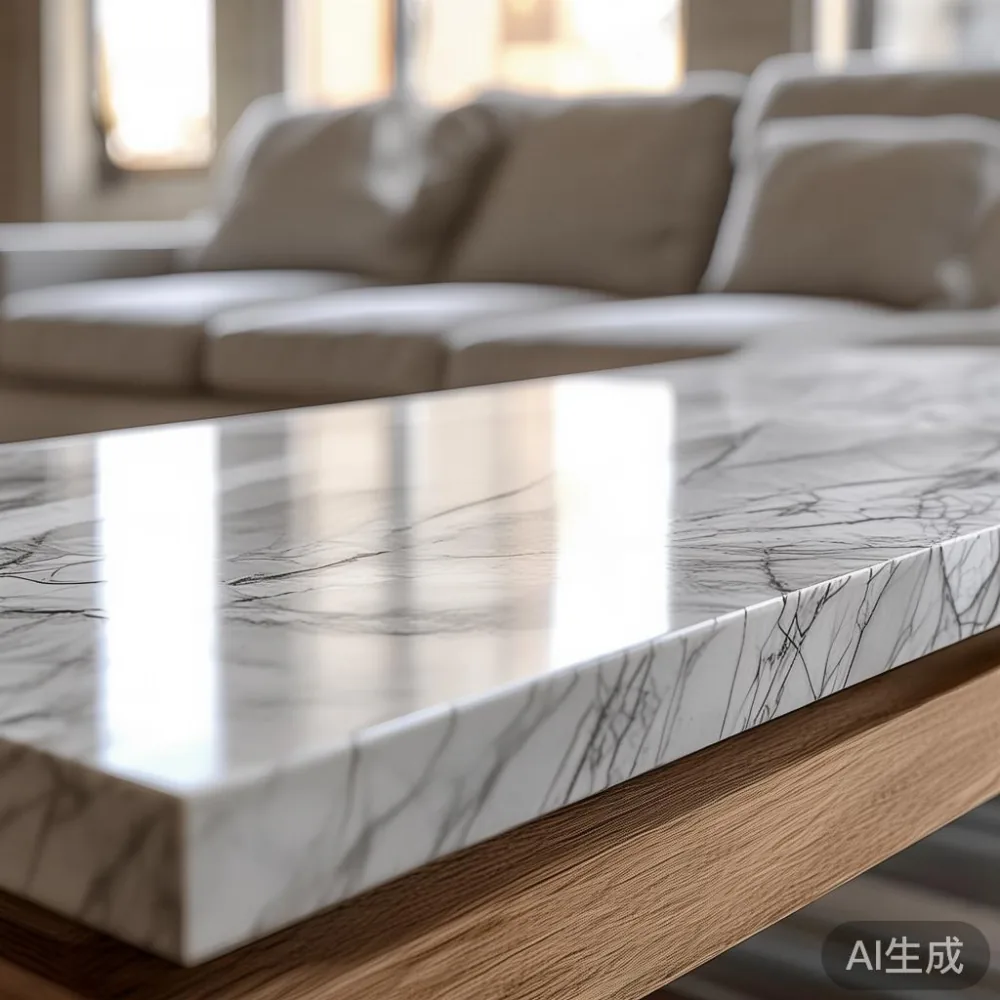
For a stone-topped option, a marble table with a 180 cm by 90 cm top can cost S$3,600 before GST. Natural marble varies in pattern, so a retailer may sell each slab as a separate item. The material is heavy: a 20 mm marble slab of this size weighs roughly 140 kg to 170 kg. Delivery may therefore require 2 workers, a lift reservation and extra protection. This is why a marble table is not merely a wood-finish comparison; its weight, installation risk and surface-care needs belong in the 5-year budget.
How do veneer and solid wood wardrobes compare over 5 years?
A 2.4 metre veneer wardrobe with sliding doors, 4 hanging sections and 8 shelves is estimated at S$1,800 before GST. A comparable solid wood wardrobe with timber framing and matching doors is estimated at S$4,200 before GST. Solid wood wardrobes are often partly engineered inside because fully solid construction across every panel would be heavy and expensive. The important points are the drawer or hanging-rail structure, the door alignment, the moisture control and the hardware.
For a typical HDB bedroom in Bedok or Tampines, a 240 cm wide wardrobe may fit against a 250 cm wall with only 5 cm clearance on each side. A 270 cm unit can crowd a window or block a projecting ledge. Before ordering, check whether the wardrobe arrives flat-packed or assembled. Flat-packed delivery can reduce corridor stress, while an assembled unit may need a second lift booking if the lift is less than 90 cm deep.
The estimated 5-year total for the veneer wardrobe is S$2,262, comprising S$1,800, S$162 GST, S$40 delivery and S$260 for one hinge adjustment, one shelf replacement and minor surface repair. The solid wood wardrobe is estimated at S$4,918, comprising S$4,200, S$378 GST, S$40 delivery and S$300 for hinge work, drawer maintenance and one refinishing session. The initial difference is S$2,400. Over 5 years, the difference is S$2,656 because solid wood doors can be sanded while laminated veneer may require a replacement panel if the paper face is badly damaged.
Singapore humidity makes care routine important. A relative humidity reading around 55% to 65% is comfortable for many timber furnishings, but bedrooms can experience condensation and temperature changes. Leave 5 cm to 8 cm between the wardrobe and a wall where possible, use a dehumidifier in persistently damp rooms and avoid direct contact with wet laundry. Neither material should be wiped with a soaked cloth.
Anyone comparing a European-style fitted unit can use a guide to how to choose European wardrobe, checking timber composition, drawer boxes, hanging space, soft-close hardware and service access. A frequent question is whether is Japanese wardrobe worth it. The answer is usually yes for a compact bedroom if the internal layout suits the household, the hardware is serviceable and the total price is compared over at least 5 years. Slim sliding doors can save 30 cm to 60 cm of floor space, although they can make only the front section of a deep rail accessible.
What does a bed frame and nightstand cost after 5 years?
A queen-size veneer bed frame with a slatted base is estimated at S$900 before GST. A solid wood queen bed frame with a similar slat system and a 12 cm to 15 cm side rail is estimated at S$1,500 before GST. For the 5-year calculation, each includes S$60 delivery, 9% GST, one repair and basic maintenance. The veneer frame comes to S$1,161 over 5 years; the solid wood frame comes to S$1,896.
The main difference in use is repairability. Scratches on a sealed veneer face may be filled locally, while a chipped solid wood rail can be sanded and matched with a clear finish if the colour has not changed too much. Centre rail supports and screw fixings should still be checked at least twice a year. A mattress that rests directly on widely spaced slats may sag faster than one supported by 12 to 15 slats or a stable deck.
A small veneer nightstand measuring 45 cm by 40 cm is estimated at S$220 before GST. A matching solid wood nightstand is estimated at S$420 before GST. Including delivery and GST, the 5-year totals are approximately S$300 and S$518. A drawer repair or replacement of 1 side rail adds roughly S$80 to the veneer scenario and S$120 to the solid wood scenario. The nightstand is a useful example of why category averages can mislead: the absolute saving is modest, while the ability to repair a timber drawer is more noticeable over repeated daily use.
Bedroom access also affects the total. A 160 cm wide bed frame with a 190 cm length needs a 210 cm to 220 cm turning area in a narrow corridor. Check the actual mattress and frame dimensions rather than relying on the queen label. Allow at least 60 cm of clear space on one side of the bed for drawers and cleaning, and at least 75 cm where a wardrobe door opens beside the bed.
How much does a solid wood sofa cost compared with a veneer sofa?
A 3-seat light grey luxury sofa with a timber frame and fabric upholstery is estimated at S$3,200 before GST. A veneer-framed equivalent is estimated at S$2,000 before GST. Upholstery, foam density, spring construction and the frame design influence price more than the visible timber in some cases. The frame may be solid wood, engineered timber or a combination, so ask for a material breakdown.
Including GST, delivery and a modest repair allowance, the veneer sofa's 5-year estimate is S$2,420. The solid wood sofa's estimate is S$3,678, including S$180 for frame sanding and refinishing. The difference of S$1,258 over 5 years is smaller than the initial difference would suggest if the upholstery remains in good condition. Fabric pets, children and sunlight can alter the appearance of both frames, and a replacement seat cushion may cost S$250 to S$500 in either case.
Measure the lift before bringing a sofa upstairs. A 3-seat sofa may arrive as 3 separate modules, each 65 cm to 90 cm wide, rather than as one 210 cm section. A compact 180 cm model may be easier to move through a corridor with 105 cm to 120 cm of width. In a smaller living area, a composition built around Minimalist for small living room principles can use a 170 cm sofa, a 35 cm side table and wall-mounted storage without making the room feel compressed.
The wording used for style can also influence the perceived value. French light luxury often leans towards pale upholstery, curved edges and restrained ornament. American light luxury commonly combines generous proportions with cleaner lines. Post-modern light luxury can mix timber, stone and patterned surfaces in a more deliberate way. For a dining setting, Modern light luxury for dining room often begins with a strong table, supported by simple chairs, a narrow pendant and one stone or ceramic object rather than many small decorations.
What maintenance and hidden costs should a Singapore buyer include?
Maintenance is where the 5-year comparison becomes more realistic. For veneer, use a dry microfibre cloth, a lightly damp cloth for dust and a mild wood cleaner recommended by the supplier. Avoid silicone-heavy sprays that can make a repaired area look cloudy. Inspect edge banding every 6 months and address lifting early. A small repair can cost S$40 to S$120; a replacement door or drawer face can cost S$180 to S$450.
For solid wood, dust with a soft cloth and clean spills promptly. Avoid placing a hot pan directly on the surface; use a trivet. Refinishing may be needed every 3 to 5 years depending on sunlight, pets and use. A professional sanding and recoating service for a dining table might cost S$180 to S$350, while a local repair of a scratch can cost S$30 to S$90. Oil finishes generally need more regular attention than a factory lacquer, but they can be maintained without replacing the entire board.
Delivery and access can change faster than catalogue prices. A normal in-stock order may be delivered in 7 to 14 days, while a custom finish can take 4 to 8 weeks. A lift reservation may cost S$20 to S$60 if the building administration charges a service fee, and a second trip can add S$50 to S$100. Measure the lift door and internal diagonal length, not just the advertised lift capacity. A 400 kg sofa should not be moved by 1 person through a stairwell; budget 2 movers or 3 where the route requires it.
Returns and warranty terms are part of the calculation, not footnotes. MIDHILL offers a 10-year structural warranty, lifetime refinishing and free shipping above US$350, with Singapore delivery arranged separately. The 14-day return period allows a buyer to check scale and finish in the actual room. These terms are most useful when compared with the seller's response time, the replacement method and the cost of returning a large item.
Which option fits a Tampines, Bedok or Punggol home better?
For a compact HDB flat, veneer can make sense where the budget is limited, the furniture will stay in one room and the surfaces will receive moderate care. A S$1,200 veneer dining table can provide useful seating without tying up S$2,200 in the same project. A flat-pack wardrobe can also pass through a narrower corridor if the panels are protected and the route has a clear landing.
Solid wood becomes more attractive in a condo that receives regular visitors, where a dining table is used daily and the owner expects to resell or refinish the furniture. A solid wood dining table, bed frame or wardrobe can carry visible timber character and tolerate localized repairs. It is not automatically the right choice for every room; its dimensions and weight may be less suitable for a tight HDB corridor.
For Singapore buyers considering a mixed-material interior, European light luxury for hotel can be translated into a compact apartment through pale oak, linen upholstery, warm lighting and one marble accent. Hotel-style planning is useful because hotel rooms solve the same problems as HDB flats: narrow circulation, limited storage and a need for furniture that looks composed without occupying too much space.
During a recent showroom visit, I tested a 180 cm by 90 cm veneer dining table and a similar solid wood table with a 20 mm top. The veneer sample resisted a damp-cloth mark well, but a deliberately lifted edge sample showed why sealing and careful transport matter. The solid wood table needed a longer sand-and-recoat sequence to restore one marked area, yet the repaired patch remained repairable rather than requiring a new top. I also checked the packed carton dimensions against a typical 90 cm lift door. One dining chair set fitted diagonally; the wider solid wood dining table required the carton to be turned in the corridor.
How should you calculate the purchase decision over 5 years?
Use this formula: furniture price plus 9% GST plus delivery plus access charges plus maintenance plus repair allowance minus expected resale value. The same formula works for a dining table, wardrobe, bed frame, nightstand, solid wood sofa or marble table. Keep the measurement notes beside the quotation, including the lift capacity, door width, corridor turns and delivery date.
For the 6-seat dining table shown here, the veneer option is lower cost over 5 years, at approximately S$1,509 compared with S$2,598 for solid wood. For the wardrobe, veneer is approximately S$2,262 compared with S$4,918 for solid wood. The solid wood bed frame is approximately S$1,896 against S$1,161 for veneer, while the solid wood nightstand is approximately S$518 against S$300. These figures show the trade-off: veneer lowers the starting price, while solid wood gives the owner more repair options and often a stronger resale proposition.
Ask the retailer for the actual panel composition, timber species, coating type, joint construction, hardware brand and warranty exclusions. For a marble table, request the slab thickness, approximate weight, lift-access instructions and installation cost. A 20 mm top may weigh 140 kg to 170 kg, while a 30 mm top can exceed 200 kg; that difference can change the delivery plan. Check whether the quoted marble table includes a protective coating, the type of support frame and the method of securing the top to prevent movement.
Choose veneer when the immediate budget is the priority, the room has stable humidity, the item will not be moved often and the seller provides clear repair information. Choose solid wood when the furniture will be used daily, the household values refinishing, the dimensions fit the building and the higher 5-year cost is acceptable. The decision is not about one material being universally superior. It is about matching construction quality, access, maintenance habits and the owner's plans to a 5-year budget measured in Singapore dollars.